Client name and project details are withheld under NDA. Visuals on this page are illustrative, not the client's product or data.
An AI Tool That Drafts Expert Witness Reports in the Expert's Own Voice, Trained on 30+ Years of His Cases
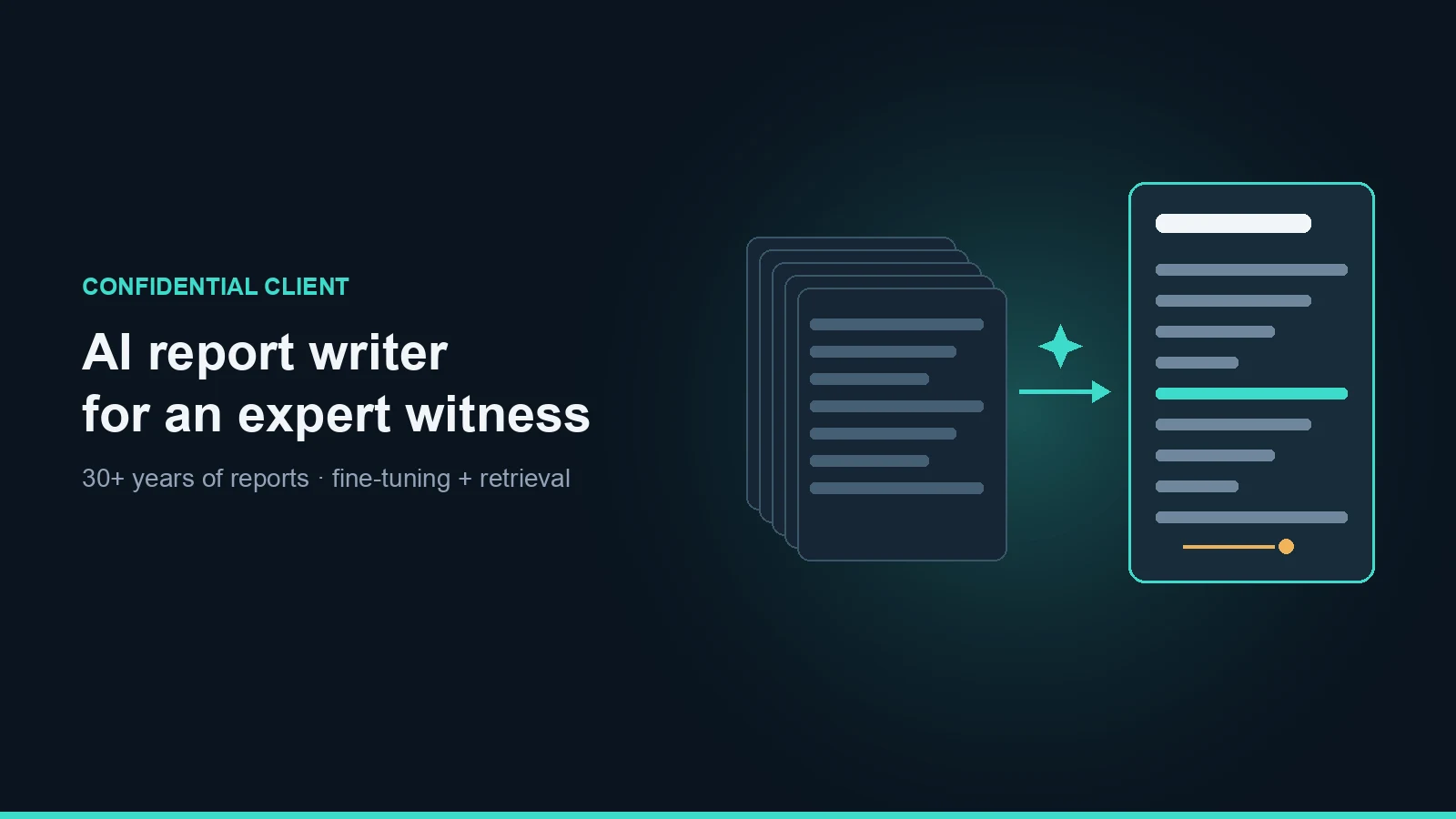
Result
Draft reports written in the expert's own tone and structure, reviewed and signed off by him
Key Results
- Trained on more than 30 years of the expert's own reports
- Fine-tuned model plus retrieval of similar past cases
- Draft reports in his own tone and structure
- Every draft reviewed and approved by the expert
Engagement
Several months
Stack Highlights
The Challenge
"A US expert witness has written reports for litigation for more than 30 years. Each report takes hours to write, and every one has to sound like him: his structure, his reasoning and his way of explaining a case. His knowledge lived in three decades of past reports that no tool could use."
Generic AI writing sounds generic, which is exactly what an expert's report can't afford. The tool had to learn from his own body of work, draw on the past cases most like the new one, and produce a draft he'd recognise as his own, while leaving every judgement and final word with him.
Our Approach
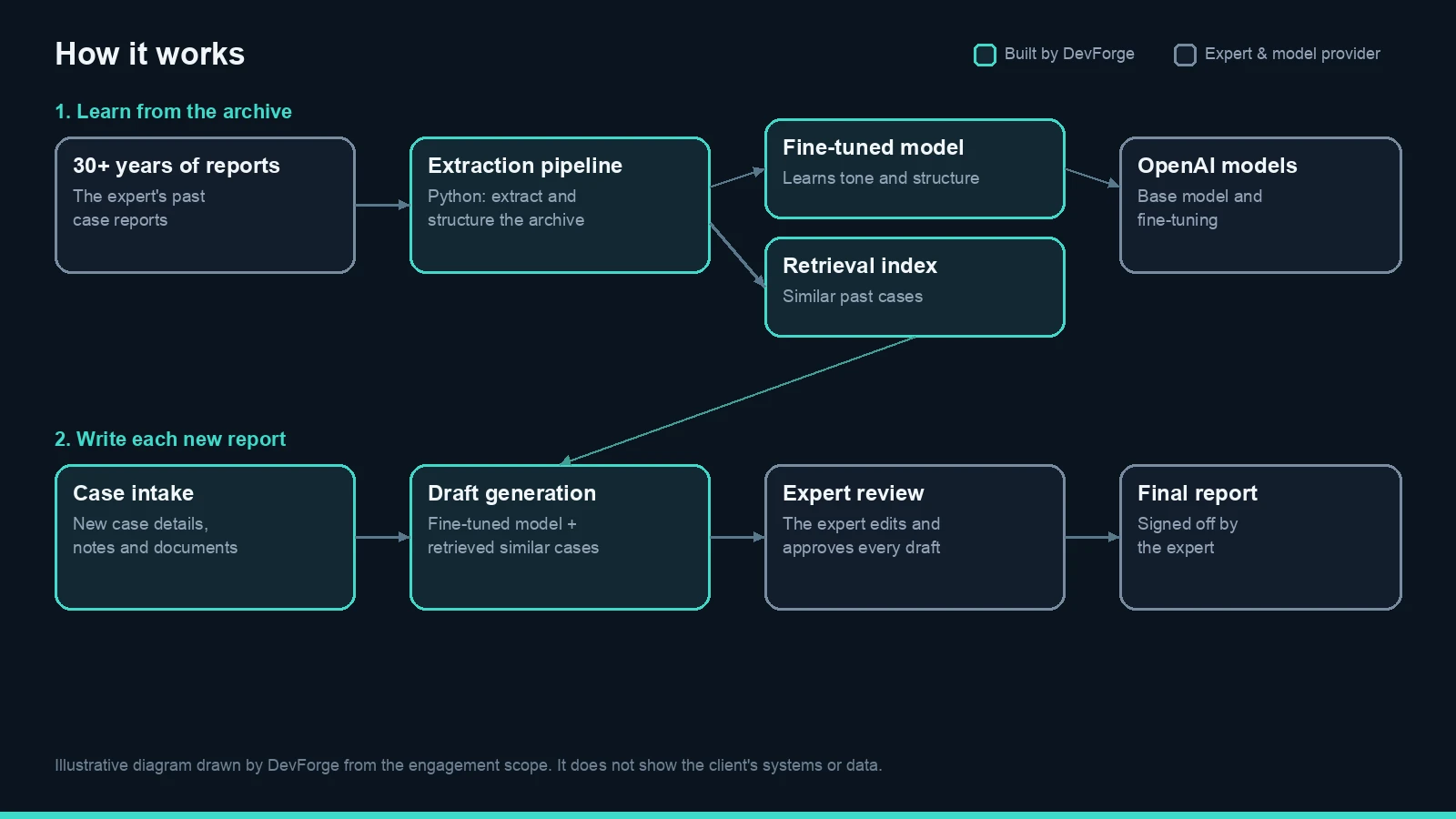
We extracted and structured more than 30 years of his past reports into usable training data. We then combined two techniques: a model fine-tuned on his reports to learn his tone and structure, and a retrieval index of past cases, so each new draft draws on the most similar cases he has already written. He enters a new case, the tool drafts the report, and he reviews and edits every draft before it's finalised.
What we built
An extraction pipeline in Python that turned 30+ years of reports into structured data, a fine-tuned OpenAI model trained on his writing, a retrieval index of similar past cases, case intake for new matters, draft report generation, and a review step where the expert edits and approves every draft.
How it works
Turning 30 years of reports into training data
An archive built up over three decades isn't ready for AI. We built a Python pipeline that extracted his past reports and structured them into consistent, usable data, which became the foundation for both the fine-tuned model and the retrieval index.
- Extraction of more than 30 years of reports
- Structured into consistent training data
- One source for fine-tuning and retrieval
Fine-tuning for his voice
Prompting a general model to 'write like an expert' doesn't capture how a specific person writes. We fine-tuned an OpenAI model on his reports so it learned his tone, his structure and the way he explains his reasoning.
- OpenAI model fine-tuned on his own reports
- Learns his tone and report structure
Retrieval of similar past cases
Style alone isn't enough; a strong draft also draws on how he handled similar cases before. A retrieval index finds the past reports most like the new case and gives them to the model as context, so drafts are grounded in his own previous work.
- Index of past cases
- The most similar cases retrieved for each new report
- Drafts grounded in his earlier reasoning
The expert stays in charge
An expert's report carries his name, so the tool drafts and he decides. He enters the new case, reviews every draft, edits it and approves the final report. Nothing is finalised without him.
- Case intake for each new matter
- Every draft reviewed and edited by the expert
- Final sign-off always his
The Outcome
The expert starts each new report from a draft that already reads like his own work, grounded in the cases he has handled before, and spends his time reviewing and refining rather than writing from a blank page.
Related case studies
More work like AI Report Writer: similar industries, services and markets.

Remote Hiring Platform
An AI-Assisted Hiring Platform With Video Interviews for a US Remote-Talent Company
Read case study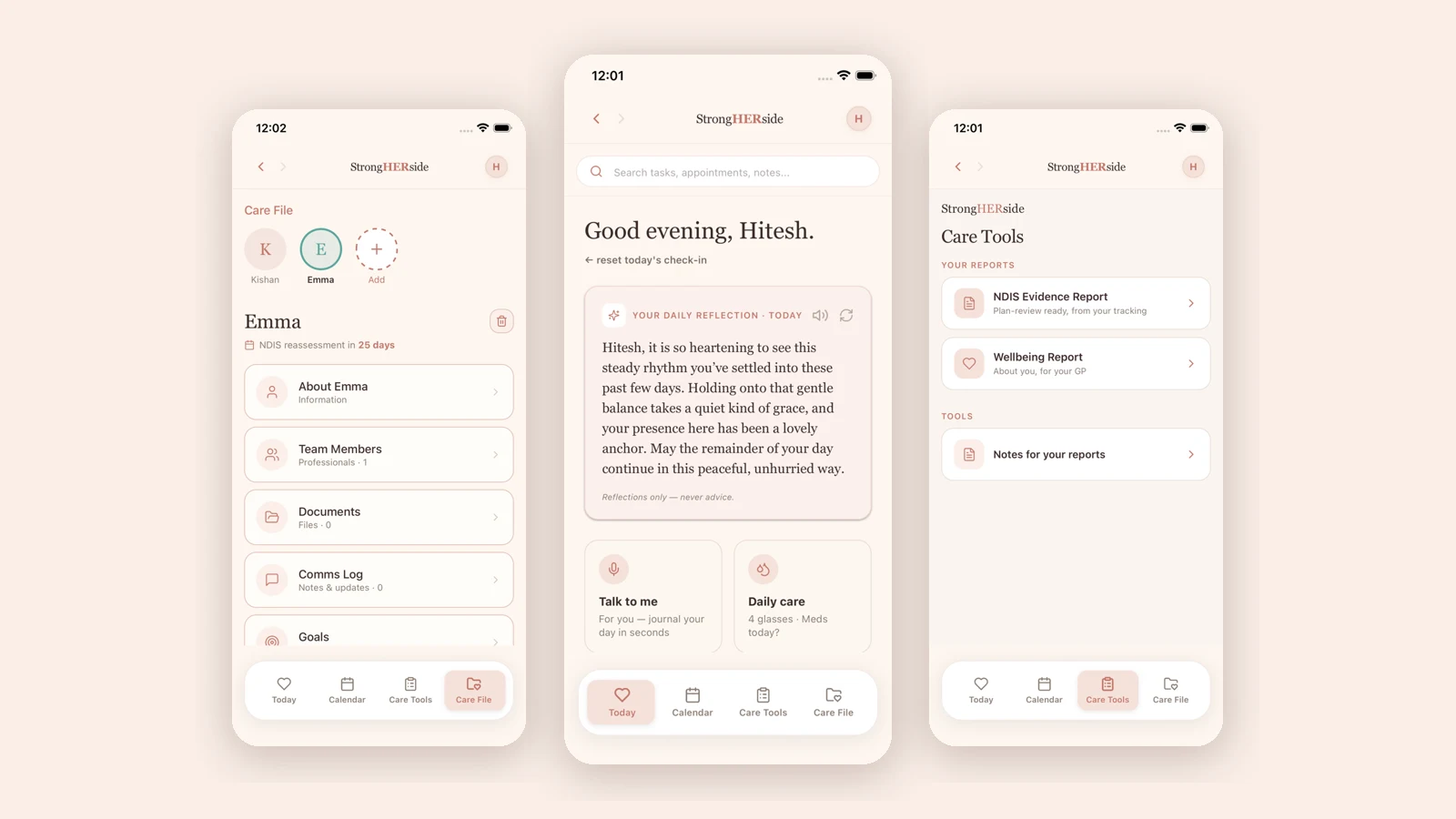
StrongHERside
A Calm, AI-Assisted Home for Mothers Raising Children With Additional Needs
Read case study
Trade IQ
An AI Compliance Assistant That Checks Trade Work On Site and Writes the Report
Read case study