Last updated: 27 September 2026
Neither route is always right: a technical co-founder is a long-term equity partnership, while an agency is a paid, scoped engagement that ends when the work is delivered. You can also use both in sequence: Y Combinator advises non-technical founders to get a first version in front of users before recruiting a technical partner, and while YC suggests no-code tools for that, an agency is another way to build it.
This guide sets out what each route costs you, what the evidence says about co-founder partnerships, and how to decide. A quick note on the data: most of the equity figures below come from Carta, whose dataset covers companies on its platform and is mostly US-based. If you are in Australia or the UK, treat those numbers as a guide rather than a local benchmark.
The short answer
Choose a technical co-founder when the technology itself is your long-term advantage and you can find the right person. Choose an agency when you need to test the idea quickly and would rather not give away a large share of the company before you know people want the product.
An agency can help you get a first version in front of users. It is not a replacement for technical leadership over the life of a company.
What a technical co-founder really costs: equity
A co-founder does not send you an invoice. They cost you ownership, and usually a lot of it.
Y Combinator's guidance is direct. In YC's Startup Library, Adora Cheung advises making a firm offer, and says that if you can't pay a salary, or the person doesn't need one, you should "propose 50/50 equity split." YC partner Harj Taggar says the same in a separate YC talk: "your sort of default equity allocation should really be 50/50."
Taggar also warns against taking a bigger share just because you started first. If you are tempted to take 70% because you've made six months of progress, he says, "I would encourage you not to do that. Startups are a really long-term game."
The market has been moving in the same direction. Carta looked at more than 32,000 companies on its platform with multiple co-founders, incorporated between 2015 and 2024.
| Two-founder teams on Carta | Earlier | 2024 |
|---|---|---|
| Share of teams splitting equity equally | 31.5% (2015) | 45.9% |
| Median split between the two founders | 60-40 (2015 and 2019) | 51-49 |
So if you bring in a technical co-founder at the start, plan on something close to an equal split. That equity is then diluted further as you raise. Carta's Founder Ownership Report 2026 found the median founding team retains about 56% of fully diluted equity by the seed round, and about 36% by Series A.
There is one thing the research does not settle: how much equity a technical co-founder should get if they join later, after you've built something. We found no reliable source for a typical figure, so we won't suggest one.
What a co-founder gives you that an agency can't
The equity is expensive because a good co-founder is worth a lot. It's worth being honest about what you get.
- Long-term ownership of the technology. A co-founder makes technical decisions for years, not for one project. They care about what the codebase looks like in three years.
- Commitment. Harj Taggar puts it plainly: with contractors, "you don't get that same emotional support that you do from a co-founder… they're not as invested in the success of the startup as you are." An agency, including ours, is paid to deliver. A co-founder succeeds or fails with you.
- Someone to argue with. Paul Graham writes that starting a startup is "too hard for one person," because you need colleagues "to talk you out of stupid decisions, and to cheer you up when things go wrong."
- Investor confidence. Adora Cheung notes that if you plan to raise money, investors will expect a technical co-founder. A 2024 YC blog post by Dalton Caldwell and Michael Seibel states that "every software company should have a technical co-founder."
None of the sources above recommends agencies. That matters. If your plan is to raise venture funding, you will almost certainly need technical leadership in the company at some point, whatever you use to build version one.
That said, going without a co-founder is becoming more common. Carta's 2026 report found that about 36% of startups founded on its platform in 2025 were led by solo founders, up from 31% in 2024. Two-founder teams are still the most common shape among startups that raise money: 36% of startups that closed rounds on Carta in 2025 had two founders, rising to 40% in SaaS.
The risks on both sides
Co-founder risk
Partnerships break. Paul Graham wrote in 2006: "About 20% of the startups we've funded have had a founder leave." He added that it happened so often that YC had started advising founders to vest their shares "so there will be an orderly way for people to quit."
Beyond that, good data on co-founder breakups is limited. Figures circulate online, but we could not verify them from primary sources, so we have left them out. The practical lesson stands anyway: use vesting, and agree on the split, roles and goals before you commit. Taggar suggests a time-boxed trial of one to three months working together on a first version before making it official.
Finding the right person is also hard, and there is no reliable data on how long it usually takes. YC Co-Founder Matching is one place to look; YC says it has made "over 100K matches."
Agency risk
Paul Graham's warning about hiring programmers applies to agencies too. Non-technical founders, he writes, "can't tell which are the good programmers," and asks: "So how do you pick good programmers if you're not a programmer? I don't think there's an answer."
That is a fair challenge. An agency's work can look fine in a demo and be hard to maintain underneath. You can also end up dependent on the agency if you don't own the code or can't access it. The sections below cover how to reduce that risk, but you should know it exists.
A decision framework
Answer these questions honestly and see which column most of your answers fall in.
| Question | Leans co-founder | Leans agency |
|---|---|---|
| Is the technology your long-term moat? | Yes: novel tech, deep engineering, hard to copy | No: the value is in the market, the customers or the service |
| Do you know a strong engineer who shares your goals? | Yes, and you've worked together before | Not yet |
| How soon do you need to test with real users? | You can afford a longer search | Soon: validation is the priority |
| Would you rather pay cash or give up equity? | Equity: cash is tight | Cash: you want to keep ownership until you have traction |
| Is the scope clear enough to write down? | No, it will change a lot as you learn | Yes, a defined first version |
| Do you plan to raise venture funding soon? | Yes: investors will ask about technical leadership | Later, after early traction |
It's also worth asking whether you need either yet. Adora Cheung points out that for "an iPhone app or website, you probably don't have to be that technical to build the first version," and suggests patching together an MVP with no-code tools to get early users. If a no-code test can answer your biggest question, start there.
Hybrid paths: agency first, technical leader next
You don't have to pick one route forever. One sequence looks like this:
- Use an agency to build a focused MVP.
- Put it in front of users and learn what works.
- Use that traction to recruit a technical co-founder, or hire a first engineer or CTO.
- Hand the codebase to them and wind down, or reduce, the agency's role.
This fits YC's advice. Cheung writes that once you've launched and have users, "it's much easier to convince and get someone technical excited to join you vs when you just have an idea." A working product is a stronger pitch than a slide deck.
The hybrid path only works if the handover works. Before you sign with any agency, insist on these four things:
- IP assignment. The contract should assign all code, designs and related intellectual property to your company. Without this, a future investor or co-founder may find you don't fully own your product.
- Repository access from day one. The code should live in a repository your company owns, with you as an administrator, from the first commit. Not "we'll send it at the end."
- Documentation. How to set up the project, how it is deployed, where the data lives and why key decisions were made. Your future CTO will need this.
- A clean handover. Agree up front how the agency will transfer accounts, credentials and knowledge to your team, and what support they give during the transition.
If an agency resists any of these, treat it as a warning sign.
How to evaluate an agency (including us)
Since you can't easily judge code quality yourself, judge the agency on how openly it answers hard questions. Ask these of every agency you speak to, DevForge included:
- Who owns the code and IP, and when? Get the answer in the contract, not just on a call.
- Can I see the repository from the first week? The answer should be a plain yes.
- Who will actually build my product? Ask to meet the people doing the work, not only the salesperson.
- What have you shipped that I can use? Ask for live products you can download or visit, and ask what the agency built versus what the client built.
- What happens when the scope changes? It will. Ask how changes are priced and agreed.
- What will you leave behind? Ask what documentation you'll get and how a handover to an in-house engineer works.
- Would you advise me not to hire you? A good agency will tell you if no-code, a freelancer or waiting for a co-founder makes more sense for you.
- Can I get an independent code review? If you know an experienced engineer, ask them to look over the repository partway through. A confident agency won't object.
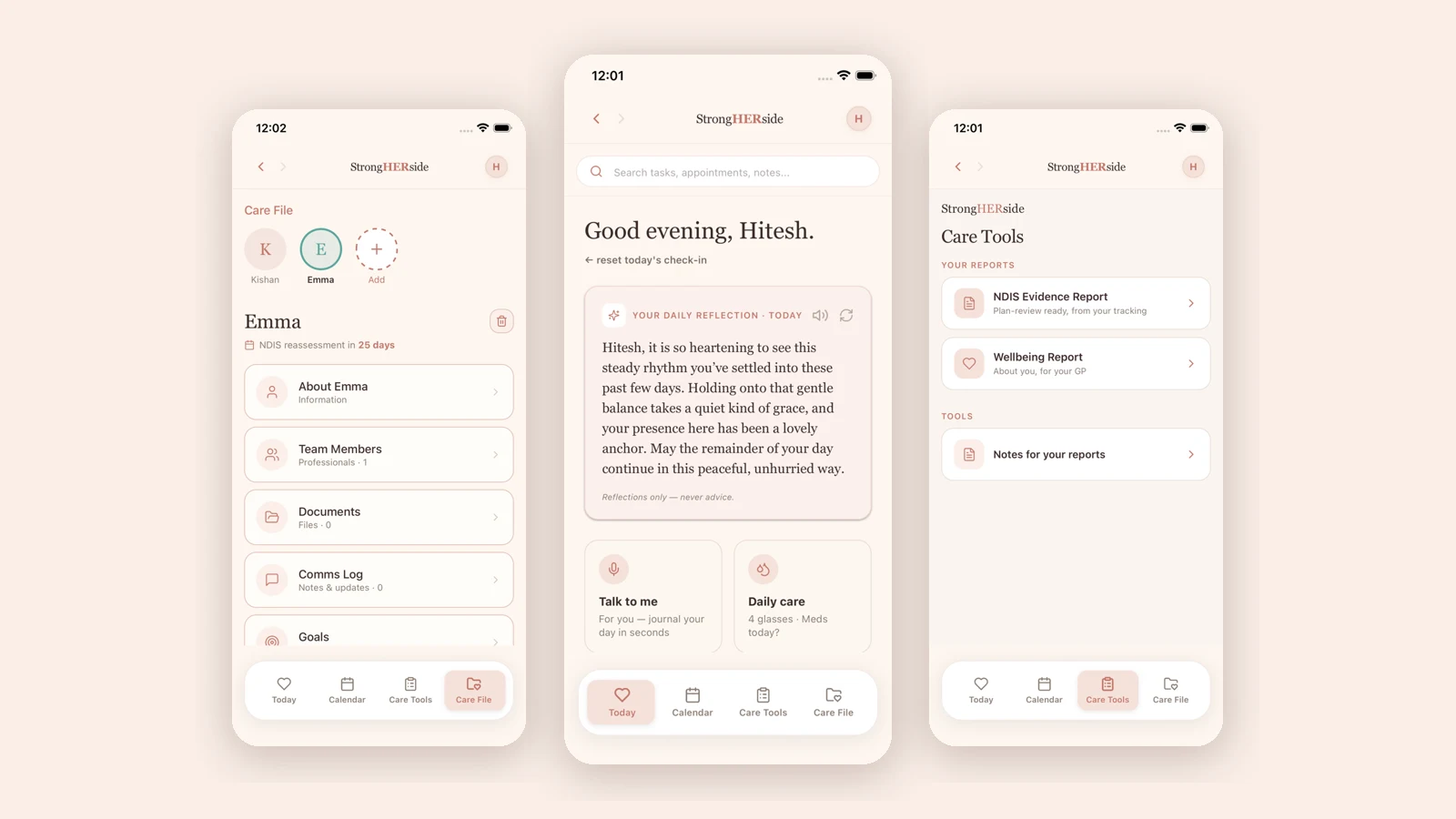
For our part, we take founders from idea to MVP in 4 to 8 weeks, you own 100% of the code and IP, and the studio is founder-led. We have four live Australian products you can look at: Gooday, Bookish, Metaboly and StrongHERside. We work with UK founders under NDA. We are also an offshore studio based in Ahmedabad, India, so ask us about time zones and communication the same way you'd ask anyone else.
How DevForge can help
If an agency-built MVP is the right next step for you, we can help you scope a focused first version that is designed to be handed over to a future technical co-founder or CTO. After a free 30-minute call, we give you a fixed estimate for phase 1. You can book a free 30-minute call, and if we think a co-founder or no-code route suits you better, we'll say so.
Read more about our MVP development service, or see how we work with founders in Australia, the UK and the US.
Sources
- Y Combinator Startup Library, "How to Find a Technical Co-Founder", Adora Cheung (created 8 June 2020): https://www.ycombinator.com/library/3i-how-to-find-a-technical-co-founder
- Y Combinator Startup Library, "How to find the right co-founder", Harj Taggar (2021 video): https://www.ycombinator.com/library/8h-how-to-find-the-right-co-founder
- Y Combinator blog, "Why do investors say you need a business co-founder?", Dalton Caldwell and Michael Seibel (11 January 2024): https://www.ycombinator.com/blog/why-do-investors-say-you-need-a-business-co-founder
- Y Combinator, "Co-Founder Matching" (no date shown): https://www.ycombinator.com/cofounder-matching
- Paul Graham, "The 18 Mistakes That Kill Startups" (October 2006): https://paulgraham.com/startupmistakes.html
- Carta, "A shift is underway in how startup co-founders split their equity" (published 20 February 2025; read via Wayback Machine snapshot of 15 October 2025): https://web.archive.org/web/20251015105534/https://carta.com/data/founder-equity-split-trends-2024/
- Carta, "Founder Ownership Report 2026", Peter Walker and Kevin Dowd (12 March 2026; read via Wayback Machine snapshot of 15 July 2026): https://web.archive.org/web/20260715082215/https://carta.com/data/founder-ownership-2026/